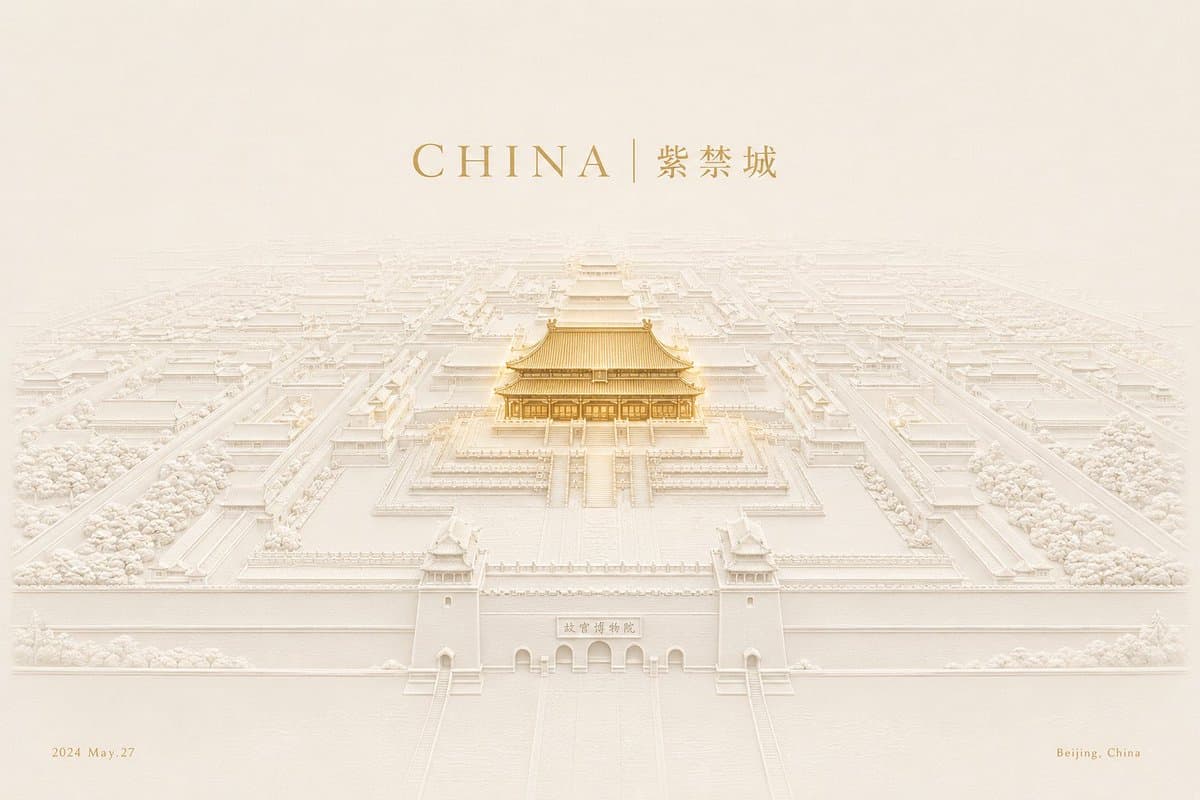
An embossed relief-style architectural poster, Chinese seal-press / paper debossing aesthetic (印压凹凸立体画风), panoramic bird's-eye view of {CITY}'s single most iconic historical or cultural landmark.

[OVERALL TECHNIQUE]
The entire image is rendered as if pressed or embossed into thick ivory-white paper or plaster — all forms are created through subtle relief, shadow, and highlight rather than flat color or line art. Minimalist line-carving technique (极简线描手法) defines architectural edges. The background is a clean, seamless ivory-white (乳白色), with no visible horizon line or sky detail — just soft gradient emptiness receding into the distance.

[LANDMARK SUBJECT — AUTO-DERIVED FROM CITY]
Identify the single most globally recognizable architectural or monumental landmark associated with {CITY} — the one structure that, if shown in silhouette alone, would be instantly identified as representing {CITY}. Render a symmetrical, wide-angle bird's-eye view of this landmark and its immediate architectural surroundings (courtyards, plazas, gardens, colonnades, gates, or approach paths — whatever is authentic to that specific landmark's real layout). The full complex recedes into the distance along a strong central axis, with repeating symmetrical structures flanking both sides in diminishing scale, creating strong linear perspective and depth. All structures share the same ivory-white embossed material as the background, distinguished only by relief depth, shadow, and fine linewidth.

[GOLD ACCENT — HERO BUILDING]
The single most iconic structure within that landmark complex is positioned at the mid-ground, centered, rendered with matte gold texture (哑金光质感) picking out its structural details — roofline, facade ornamentation, columns, doorways, or spire, whatever is architecturally authentic to it. This building's edges emit a low-intensity warm white glow (低亮度白光), as if lit from within or by soft dawn light, making it the clear focal point against the otherwise monochrome ivory scene.

[TYPOGRAPHY]
Centered in the composition, positioned in front of or just above the hero building: a serif wordmark reading the country or region name in English, followed by a vertical bar, followed by the landmark's name in its native language and script — e.g. formatted as "{COUNTRY} | {LANDMARK NATIVE NAME}" — in elegant refined gold serif type. The text width spans roughly half the frame's width — commanding but not oversized.

At the bottom of the composition:
- Lower left corner, very small text: today's date in "YYYY Mon.DD" format

Both in the same muted gold tone, minimal, unobtrusive.

[COMPOSITION]
Wide symmetrical composition, camera positioned at a high elevated angle looking down the central axis of the complex. Negative white space occupies approximately 60% of the frame — generous emptiness above and around the architecture emphasizes depth, scale, and stillness. The vanishing point sits at the upper-center of the frame, where the architecture recedes into soft white haze.

[STYLE REFERENCES]
Combine: Akira Yamaguchi's meticulous architectural detail work, Tadao Ando's minimalist symmetry and negative space philosophy, Zao Wou-Ki's abstract sense of spatial depth, George Segal's soft sculptural relief quality, and Wim Wenders' elevated urban framing sensibility. The embossed texture should feel naturally hand-pressed — uniform, clean linewidth with no visual noise or artifacts.

[QUALITY & MOOD]
8K quality rendering, rich fine detail throughout, evoking a serene, radiant atmosphere (宁静辉光). The image should feel like a reinterpretation of {CITY}'s most iconic landmark — where historical weight and contemporary art intersect — delivering a visually tranquil yet culturally resonant narrative.